
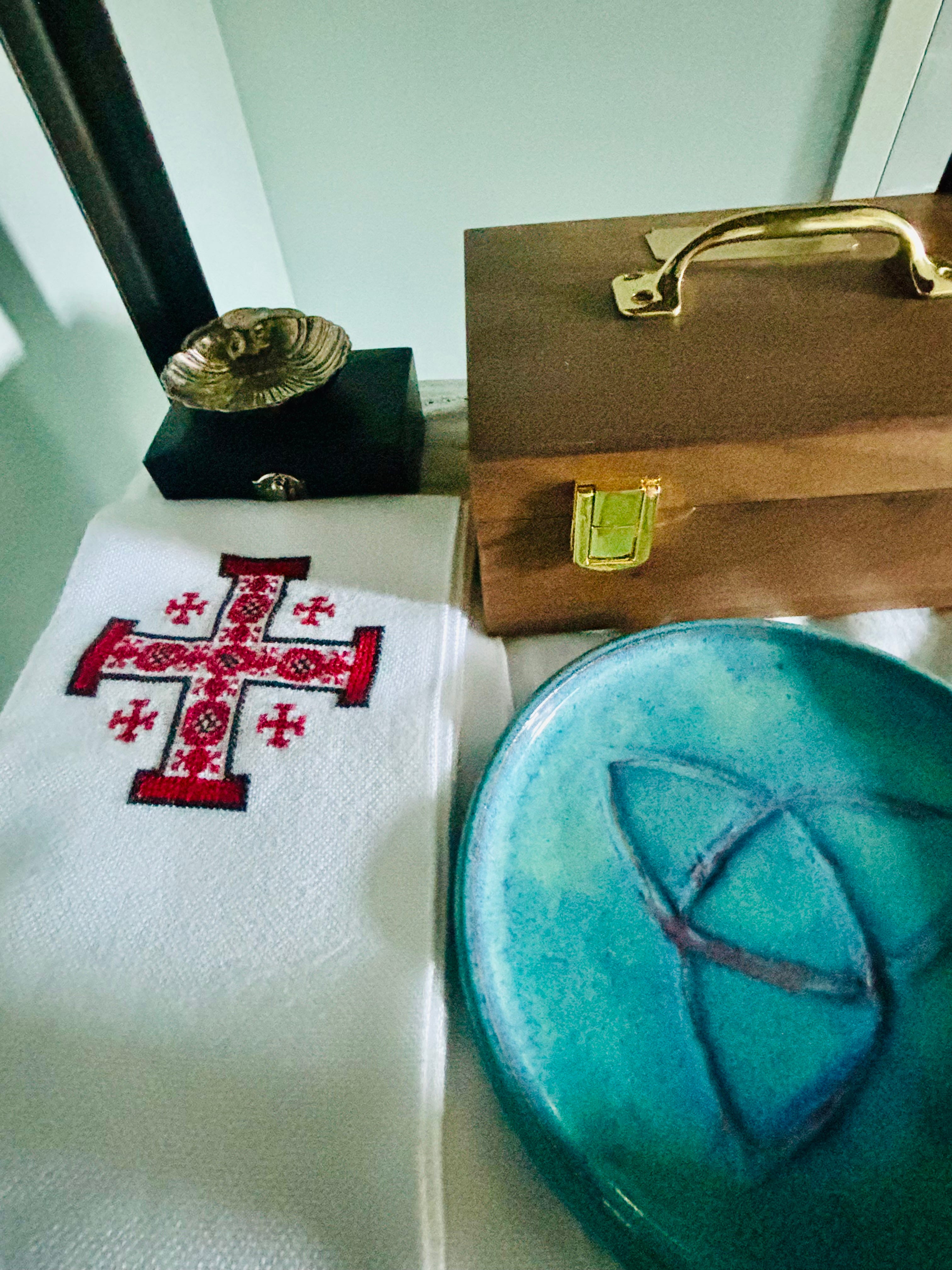
Serving God visibly
What we're called to shines through us.
Here’s a few things that happened to me this week:
My real estate agent asked me to bless her new house.
My neighbor asked me to go on a walk to talk through a family problem.
I stopped to chat with another neighbor and he ended up telling me about some things he’s struggling with.
A colleague texted me some questions as she ponders where her ministry is heading.
A friend from across the country called to talk about some struggles she’s having with church.
My husband sometimes mock-complains that we can’t get through the grocery store or a restaurant without me eliciting the life story of the people who work there or are in line with us.
This is not humble-bragging. It’s not about me at all. It’s my vocation.
All these people know I am a priest - well, most of them do. I usually only tell those in line at the grocery store after they start telling me their life stories!
I guess its sort of like when people know you’re a doctor, so they just present their ailments to you at a party and hope for a diagnosis (I may be guilty of doing that…).
When people know you are a living symbol of God’s love in the world, they tend to gravitate towards that.
It’s weird to say that, but I think it’s true. In the same way that doctors are a living symbol of healing in the world, clergy represent something, regardless of what kind of people we are. People feel it - connect to it - the need for spiritual healing.
I’m reading through Michael Plekon’s book ‘Ministry Matters’ on this blog, and we’re on chapter one: ‘Why Examine the Ordained and Their Ministry?’
Plekon asserts that clergy ministry ‘is essential to the life of a community of faith’, and also that ‘neither pastors nor parishes can exist just for themselves.’
I agree with this, and I would take it one step further:
‘neither pastors nor parishes can exist just for each other, either.’
In my own ministry, I’m often asking myself and others ‘what’s your job here?’. It’s important to make the distinction between what you’re called to and what the work is.
I have a job - actually, several. I serve a congregation - as a sacramentalist, preacher, and pastor - and get paid for the hours I serve there. I also teach and set up digital ministries for congregations and dioceses, write a blog, and coach ministers. All of these are ministry, though only the sacramental part of my work actually requires me to be ordained.
My ordination is about my vocation - my calling. It’s the essence of something I carry with me, and share with the wider community. My ministry is the work that I do to share God’s love in the world. There’s lots of overlap, but it’s not complete.
I happen to believe we all have a vocation - something larger longs to shine through each of us.
Plekon uses a quote from Barbara Brown Taylor to begin the first chapter of his book:
’Being ordained is not about serving God perfectly, it’s about serving God visibly’.
My vocation makes me visible, and in this way I serve everyone, everywhere. I accept that I am a symbol of something that others connect with.
We don’t just exist for ourselves, and clergy and congregations don’t just exist for each other, either. We exist for all those we meet along the way - especially those who will probably never even consider entering a church.
I believe that my vocation is essential not just to the church, but to the world. When even my athiest friends ask me to pray for them, I know this is true.


I loving that book. Thx for sharing it in an earlier post.
What you say here is so true. My ministry takes me many places and back again. I have people who no longer come to our community or church at all and will reach out for prayer, a conversation etc. I’m also invited to pray at the harvest at a local winery. I never want to loose the sense of awe of Gods presence in all things.
This week my ministry took my down the slide on the playground with a child who asked me go down the slide with him a Jesus. Doesn’t get better than that.